After watching China's military parade, Putin and Trump even got into a verbal spat.
First point.
There's no doubt that both Putin and Trump watched China's September 3rd military parade—Putin witnessed it live, while Trump viewed a video recording.
How do you know?
Trump said so himself.
Second point.
Undoubtedly, after watching the Chinese parade, neither leader felt entirely at ease. Putin praised it as “spectacular, truly impressive, and of the highest caliber.” Trump, however, seemed somewhat conflicted—acknowledging its grandeur while harboring a sense of disappointment.
In any case, this historic parade became an inescapable topic for him that day—a thorn in his side.
On his social media, he first acknowledged America's “immense support and bloody sacrifices” during China's resistance against Japan, stating this must not be forgotten. He then wished Chinese leaders and the Chinese people “a great and enduring celebration.”
What followed carried a hint of sourness.
Trump wrote: “Please convey my warmest regards to Vladimir Putin and Kim Jong Un as you conspire against the United States of America.”
How should this be interpreted?
1. To say Trump was unfriendly doesn't quite fit either—he addressed Putin intimately by his full name and even extended “warmest greetings” to both men.
2. To say Trump was pleased seems equally implausible. He muttered, “You are plotting against the United States.”
3. Then there's the intriguing line: “Please convey my regards to...”
Who would convey them?
He posted this on social media—clearly not addressing journalists. Could it be his followers?
But how could his followers reach Putin and Kim Jong-un?
That leaves one possibility: the person Trump entrusted with this message might be the Chinese leader he just wished well...
During his meeting with Polish President Duda at the White House, Trump couldn't resist mentioning Beijing's military parade again, exclaiming: “It was a beautiful celebration. I think it was very, very impressive. I understand why they did it. They wanted me to watch, and I was watching...”
Trump was clearly deeply moved.
Whether by coincidence or design, on September 3rd, Trump also arranged a “mini-parade” in Washington.
Multiple F-16 and F-35 fighter jets flew in formation over the White House. Trump and Duda paused to watch.
The stated reason for the “flyover” was to honor Polish pilots killed in a recent plane crash.
That explanation sounds a bit odd.
But regardless, some of Trump's discontent was heard by Putin in Beijing.
In international politics, the loudest declarations often lie not in speeches, but in the unspoken subtext.
At his farewell press conference in Beijing, the ever-diplomatic Putin swiftly responded.
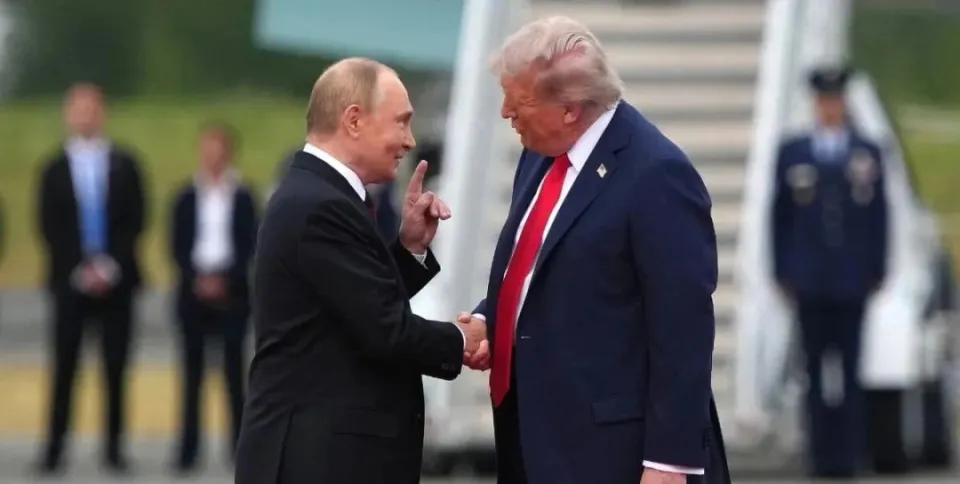
“The U.S. president is not without a sense of humor—that much is obvious, and we are well aware of it,” Putin stated. “I have established a good relationship with him, and we address each other by first name.”
Putin added, “I can tell you that I hope he [Trump] hears this too. Though it may seem strange, during these four days in China, in all the informal and formal talks, no one has made any negative comments about the current U.S. administration.”
Putin noted that during this visit to China, every foreign leader he met expressed absolute support for the recent summit he held with Trump in Alaska.
Putin remarked: “Since I'm making these statements publicly, where the whole world can see and hear them, that's the best guarantee that what I'm saying is true... If it weren't so, I would never do this, because then I would lose face in front of my friends, allies, and strategic partners.”
What does this mean?
Putin's meaning is quite clear.
1. Trump, you're too funny.
2. We know each other well—we call each other by first names.
3. Trump, don't overthink it—we genuinely aren't plotting against the U.S.
4. Every leader here in China has expressed support for our Alaska summit.
5. I'm definitely telling the truth—otherwise I'd lose face.
In short, Trump, oh Trump—you're just overthinking it.
Of course, Putin's historic visit—attending the SCO summit in Tianjin and the military parade in Beijing—left him with profound impressions.
He stated, “The unipolar world must cease to exist,” as it has become obsolete. “In this multipolar world, everyone enjoys equal rights,” and “you cannot engage in dialogue with India or China in such a manner”...
Putin, you must have had specific targets in mind.
Finally, what's your take?
These are purely my personal views, representing no institution, and remain rather superficial.
First, we should acknowledge Trump's goodwill.
He publicly wished Chinese leaders and the Chinese people “a great and enduring celebration.”
Such directness is rare.
Frankly, Biden or Obama would never utter such words.
After all, wasn't China's victory back then also America's victory?
Trump also noted that Americans helped China “expel extremely unfriendly foreign aggressors” at the time, making significant sacrifices.
This is indeed factual.
Thus, during this military parade, I observed that while the Chinese leader's speech was brief, it began with: “We extend our heartfelt gratitude to the foreign governments and international friends who supported and assisted the Chinese people in resisting aggression!”
The Chinese value distinguishing gratitude from grievances. In my view, the first foreign government to thank must surely be the United States of that era.
Thus, from this perspective, China has long addressed the concerns Trump holds dear.
Oh, and among the spectators at Tiananmen Square were many American friends, including descendants of the Flying Tigers.
Second, watching the two presidents spar is quite entertaining.
Trump's style is direct, impulsive, loaded with adjectives and exclamation points—and prone to wild exaggerations.
We must take him seriously, after all, he is the President of the United States.
But we shouldn't take him too seriously either, for he also holds another crucial identity: America's ultimate internet sensation. The defining trait of such figures is their relentless pursuit of shocking statements.
Some of his remarks are likely just off-the-cuff remarks that shouldn't be taken too seriously.
For instance, when he said he wanted to take Alaska from Russia—could anyone take that seriously?
Putin's traits include meticulousness, quick wit, and dry humor. He certainly knows how to handle Trump.
So when Trump voiced his dissatisfaction, Putin responded immediately.
His words were sincere, artfully delivered, and even tinged with a hint of solemn vow.
Trump, you have to believe me.
Trump couldn't help but believe him. Just wait—in a few days, he'll surely shift his tone when discussing Putin and Kim Jong-un.
The rivalry between great powers is like undersea currents: calm on the surface, yet turbulent beneath. True intentions often lie hidden behind public rhetoric.
Third, it must be said that Trump is missing out by not coming to Beijing this time.
The people he most longs to meet are all in Beijing.
The military parade he most longs to see will undoubtedly be the most magnificent in Beijing.
Moreover, with Putin and Kim Jong-un both attending in person, he'll be stuck watching it on TV in Washington. Would you feel good about that?
Had he actually come to Beijing, as President of the United States, given the history of U.S.-China alliance against adversaries, and especially considering our Chinese hospitality, his reception would have been no less grand than Putin's!
Once missed, forever regretted.
From this perspective, we should also understand Trump. Even in a foul mood, he still magnanimously extended his blessings to China—truly commendable.
The next major military parade in China will likely be for the 80th anniversary of the nation's founding—in 2029. By then, Trump will long have ceased to be the U.S. president.
In this world, many things, once missed, are lost forever.