

New discoveries have been made at the Mausoleum of the First Qin Emperor!
Recently, the Qin Shi Huang Mausoleum Museum collaborated with University College London to publish a new study titled “Wooden Architectural Structures at the Mausoleum of the First Qin Emperor” in the internationally renowned archaeological journal Antiquity. This research systematically reveals for the first time the utilization of timber resources during the construction of the Qin Shi Huang Mausoleum (hereafter referred to as the “Qin Mausoleum”), providing crucial insights into the Qin state's resource mobilization and labor organization.
According to researchers, wooden remains within the Qin Mausoleum complex are primarily concentrated in burial pits and subsidiary tombs. Among these, the highest number of carbonized remains are preserved in burial pits that were deliberately burned. This study systematically examined 657 charred wooden architectural component samples collected from Pits 1 and 2 of the Terracotta Warriors, the Acrobatic Figures Pit, and the Stone Armor Pit. All samples originated from structural elements within the figurine pits, including roof rafters, columns, beams, floor joists, and side-wall timbers.
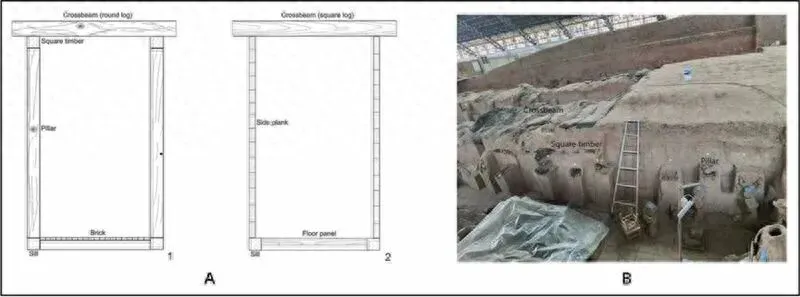
Schematic Diagram of the Main Timber Frame Structure in the Passageway of the Burial Pits (A1: Terracotta Army Pit; A2: K9901 and K9801) and Carbonized Timber Architectural Structure in Pit No. 1 of the Terracotta Army. Image courtesy of the Qin Shi Huang Mausoleum Museum
Research indicates that the timber used for architectural components in the investigated burial pits primarily originated from dark conifer species belonging to the genera Abies, Picea, and Tsuga. These trees were sourced from high-altitude mountainous regions, and Mount Li—the closest mountain to the Qin Mausoleum—lacks the conditions necessary for growing these species. In terms of straight-line distance, the higher peaks in the eastern section of the Qinling Mountains might seem a more convenient source. However, actual timber procurement involved numerous factors beyond distance, such as transportation feasibility and cost. Current evidence is insufficient to refute Sima Qian's account in the Records of the Grand Historian that the timber for the Qin Mausoleum originated from “the regions of Shu and Jing.”
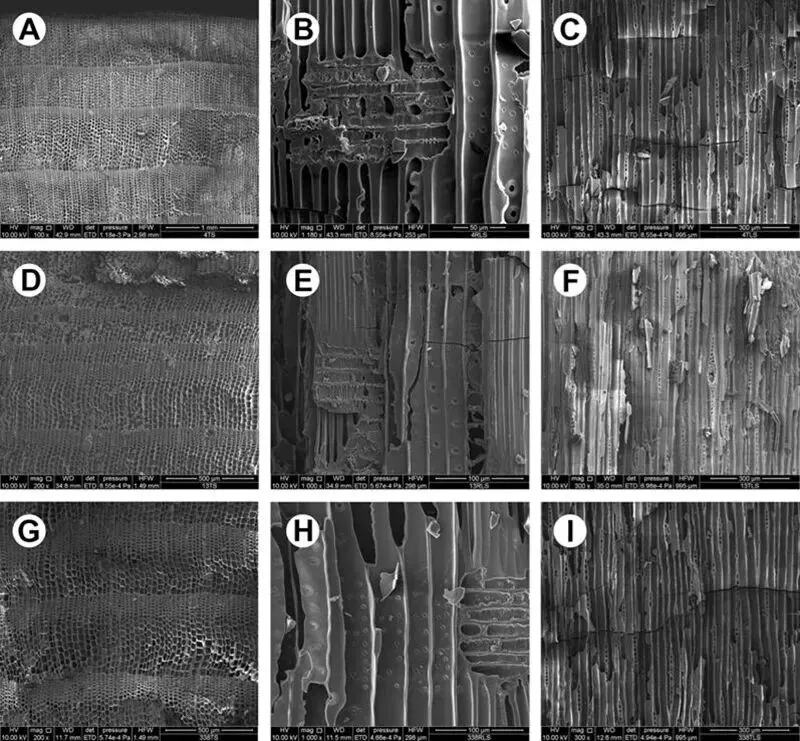
Microscopic Structure of the Genera Abies, Picea, and Tsuga. Photo courtesy of the Qin Shi Huang Mausoleum Museum.
Concurrently, dark coniferous species belong to the pine family, broadly classified as pine wood, while Chinese juniper and cypress species constitute cypress wood. The Book of Rites: Grand Records of Mourning states: “The ruler's coffin is made of pine; the minister's, of cypress; the scholar's, of mixed woods.” Consequently, some scholars suggest that the use of cypress or pine wood may reflect hierarchical distinctions. Experts indicate that insufficient evidence has been found to demonstrate that the use of cypress or pine wood directly reflects differences in rank or other symbolic meanings.
Researchers indicate that as construction progressed, the elevation at which primary coniferous timber species were sourced gradually increased. This suggests the wood likely originated from mountain forests with relatively concentrated spatial distribution. The selection of timber components in the investigated terracotta pit structures was influenced by changes in the mountain coniferous forest vegetation being harvested. This also implies the significant impact of the mausoleum construction project on the harvested mountain vegetation.
This study represents the first systematic investigation of the Qin Mausoleum's wooden architectural remains, encompassing all excavated burial pits currently accessible for direct sampling. This not only refines previous small-sample analyses of timber utilization at the Qin Mausoleum, revealing similarities and differences in material selection patterns between various architectural components within the same burial pit and across different burial pits, but also provides evidence for exploring timber resource collection strategies and material selection factors during the mausoleum's construction.