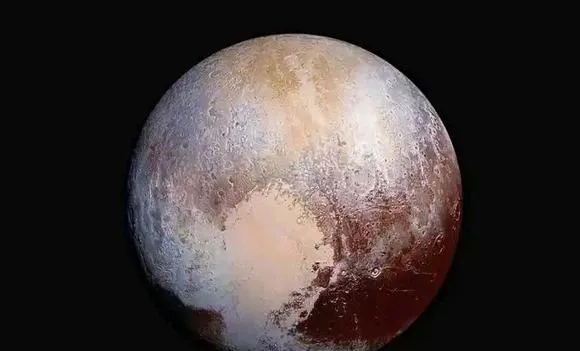

Three key points for Pluto's classification as a dwarf planet
Pluto is no longer classified as a major planet and has been reclassified as a dwarf planet based on three main points:
The third criterion of the planet definition
The International Astronomical Union (IAU) revised the definition of a planet in 2006, with the third criterion stating that a planet must "clear its orbit of other objects." Pluto is located in the Kuiper Belt, an area filled with many icy small bodies. Pluto's mass and volume are insufficient to clear other small bodies near its orbit, thus it does not meet this criterion of the planet definition.
The discovery of Eris
In 2005, astronomers discovered Eris, a distant icy body with a mass comparable to or even greater than Pluto's. The discovery of Eris further proved that Pluto is not the only body in its region (the Kuiper Belt), prompting the IAU to revise the planet definition. If Pluto were defined as a planet, then similar bodies like Eris would also need to be classified as planets, leading to a sharp increase in the number of planets without significant differences between these bodies.
The physical characteristics of Pluto
Pluto's volume and mass are relatively small, with a diameter of about 2,376 kilometers, smaller than Earth's moon, and a mass only 0.2% that of Earth. Additionally, Pluto is primarily composed of rock and ice, has an extremely low surface temperature, and a thin atmosphere. These physical characteristics make Pluto notably different from other major planets (such as Earth and Mars).
In conclusion, because Pluto does not meet the IAU's third criterion for planet definition (clearing its orbit of other objects), and due to its distinct physical characteristics and environment compared to other major planets, it is no longer defined as a major planet but is classified as a dwarf planet.