

America's “luring South Korea with investment incentives” is actually a “bait-and-switch.”
“Welcome Korean investment to the United States!” — Yet after South Korea left its money and technology behind, the Trump administration brandished the scythe of reaping under the guise of “illegal visas.”
On September 12 local time, the 330 individuals arrested in the U.S. finally returned to Incheon Airport in South Korea. It had been eight days since their detention by U.S. Immigration and Customs Enforcement (ICE) on September 4.
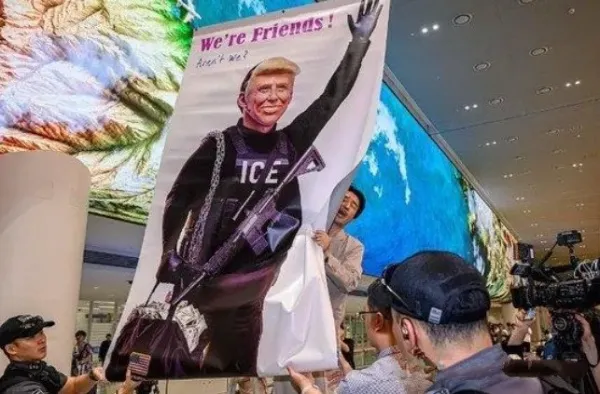
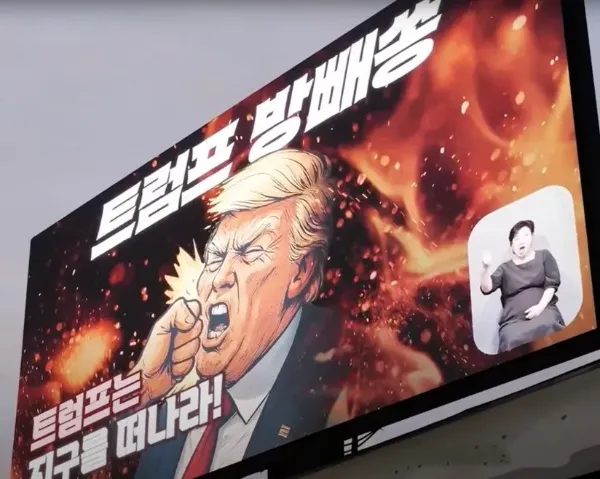
However, the diplomatic friction between the U.S. and South Korea triggered by this unprovoked raid—along with nationwide resentment toward America—is far from over. Not only have anti-Trump protests erupted across South Korea, but large crowds have gathered outside airport terminals demanding an apology from President Trump. Demonstrators held signs mocking an ICE-uniformed “Trump” figure, with slogans reading: “You invited us to invest, then arrested us! Is this how you treat allies?”
Why has South Korea, once willing to play the loyal subordinate to the U.S., now “stood up for itself”?
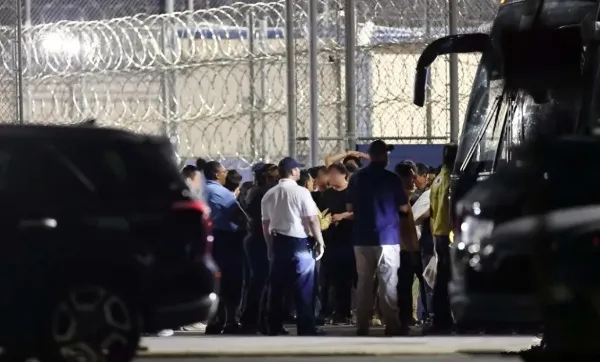
The story began ten days earlier. On September 5 local time, a large contingent of U.S. Immigration and Customs Enforcement (ICE) and Homeland Security Investigations agents suddenly surrounded the construction site of a battery factory jointly built by Hyundai Motor and LG Energy Solution in Georgia. They detained 475 workers in one fell swoop, over 300 of whom were South Korean nationals.
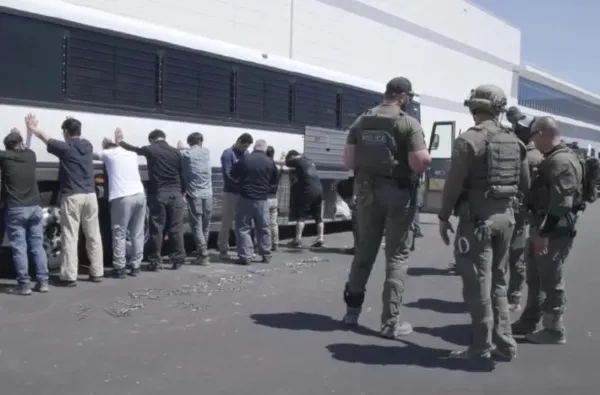
These Korean workers entered the country on valid visas—some under the ESTA visa waiver program, others holding B-1 business visas. They crossed oceans to Georgia to build a $4.3 billion power battery factory, originally slated to begin production next year with an annual capacity sufficient to power 300,000 electric vehicles.
But U.S. Immigration and Customs Enforcement delivered a stark lesson in American law: ESTA and B-1 visas do not permit construction work in the United States—not even for building factories for American companies.
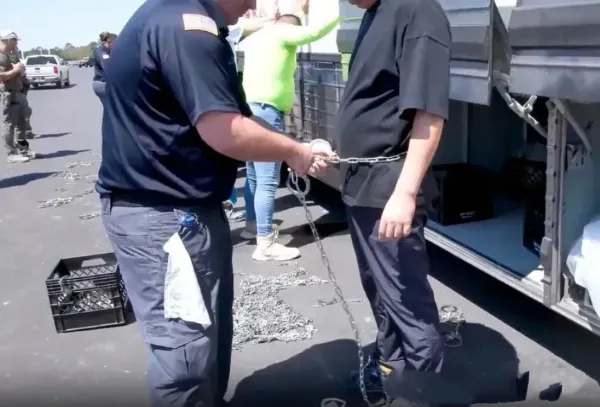
Thus, these skilled workers were instantly transformed from “welcomed foreign investors” into “illegal workers,” handcuffed and shackled as they were led away in a scene reminiscent of apprehending serious criminals.
A detained South Korean employee later described in a publicly released “detention diary”: "Eighty people were crammed into one room at the detention center. Moldy mattresses, foul-smelling water—even basic physiological needs were difficult to meet. Initially, there were no blankets, and he could only stay warm with a towel brought by a friend. It wasn't until the fourth day that he was transferred to a room shared by two people."
ICE conducted the first interrogation only on the third day of detention and demanded the workers sign “voluntary departure” documents—a term repeatedly stamped with the word “illegal.” When the Korean employee explained he was on a legitimate business trip, officials responded with mockery and ridicule. Feeling humiliated and furious, he feared rebutting would worsen his situation and endured in silence.
These images sparked intense outrage in South Korea. Many Koreans felt betrayed by an ally: “Is this how America treats its friends?”
Following the incident, the South Korean government urgently chartered a flight to repatriate 316 detained personnel. Ironically, only one chose to remain in the U.S.—a figure that speaks volumes.
The fallout from this fiasco continues to unfold. Hyundai Motor CEO José Muñoz finally broke his silence at an auto news conference on September 11, explaining: The construction phase of the battery plant requires specialized personnel, as many technologies and equipment are unavailable in the U.S."
This was a diplomatic way of saying: The U.S. simply lacks sufficient technical talent to build such a high-tech factory!
This marked Hyundai executives' first public statement following the U.S. immigration authorities' large-scale enforcement operation, signaling that the $4.3 billion battery plant—originally slated for year-end production—would inevitably be delayed until 2026.
More critically, this incident may have long-term repercussions for U.S.-South Korea economic relations.
Lee Jae-myung, leader of South Korea's largest opposition party, candidly stated at his 100-day press conference: “This could significantly impact South Korea's future direct investments in the United States.”
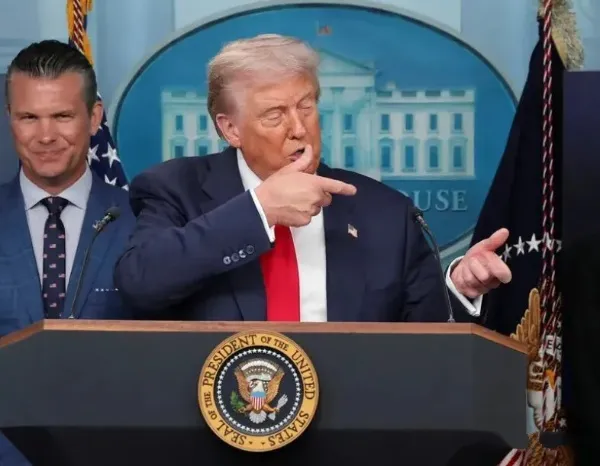
Nikkei Asia incisively points out that this incident highlights a stark contradiction between two key policies of the Trump administration: on one hand, cracking down on immigration and deporting undocumented immigrants; on the other, pressuring foreign companies with advanced technologies to establish factories in the United States.
Put plainly: the Trump administration wants foreign companies' investments and technologies, but doesn't want the foreign workers these companies bring. This contradictory “have-your-cake-and-eat-it-too” policy ultimately erupted in the absurd pretext of arresting immigrants.
Ironically, just days earlier in late August, Lee Jae-myung visited the U.S. with a $350 billion investment pledge from South Korea. The recently concluded Korea-U.S. trade agreement had raised high hopes for future cooperation in shipbuilding, semiconductors, and other sectors. Yet barely two weeks later, U.S. inspection authorities raided a South Korean company's American factory.
Following the incident, South Korean officials revealed that Trump had actually encouraged the released Korean workers to stay in the U.S.—to train Americans.
This “carrot-and-stick” approach was unanimously rejected by the workers. One family member stated bluntly, “I will never let my family set foot in the U.S. again.” Another worker remarked, “I don't think anyone wants to stay in the U.S. anymore.”
A recent survey reveals that 10 out of 14 Korean companies interviewed have explicitly stated they are considering adjustments to their U.S. project plans. Lee Ho-geun, an automotive industry expert at Daegu University in South Korea, predicts: “If this policy uncertainty continues to worsen, Korean automakers may completely withdraw from the U.S. market and shift their investment focus to more stable and predictable regions like Latin America, Europe, or the Middle East.”
This incident serves as a wake-up call for the world's so-called U.S. “allies”:
First, the status of being a U.S. “ally” does not shield companies from the pain of policy reversals. Even allied enterprises that bring substantial investment and job opportunities can become casualties of domestic political struggles in the United States.
Second, the extreme enforcement of immigration policies has begun to undermine U.S. economic interests. When skilled workers cannot even carry out normal work activities, the so-called “revival of manufacturing” risks becoming nothing more than a slogan.
Finally, this incident may mark a turning point for multinational corporations reassessing the U.S. investment environment. When policy risks become so unpredictable, businesses will naturally seek more stable investment destinations.
The Hyundai-LG battery plant incident may be just the beginning, not the end. Against the backdrop of U.S. political polarization and heightened sensitivity toward immigration issues, similar conflicts could well resurface in other foreign investment projects.
The Trump administration appears unaware that in the age of globalization, capital and technology have legs—they flow to places that welcome them rather than arrest them. Shouting “Make America Great Again” while shackling the very skilled workers who come to help build the country is a contradictory approach that will ultimately turn the “American Dream” into an “American Nightmare.”
For South Korean companies that once embraced U.S. investment with enthusiasm, this incident is undoubtedly a cold shower—while the American market offers vast opportunities, its policy risks loom even larger. Perhaps, as that Korean worker remarked, “I'm not sure if we'll ever go back.”
After all, who would want to invest in a place that might shackle you at any moment?